
 Age: 1 year
 Plants 1 new Olive tree
 CO2 absorbed: 150 kg/year
 Evo oil included:




Introduction - The Capabilities of Olive Trees
Have you ever wondered how much CO2 an olive tree absorbs? To answer this question, we first need to take a step back and understand what it means to “absorb CO2” and why it’s so important for the planet.
Olive trees, the iconic trees of the Salento region and, more broadly, of the Mediterranean scrub, are regarded as true heroes:
- They produce olives, from which a highly prized condiment is made: olive oil (click here to find out how many types of olive oil there are);
- They are a fundamental part of our animal and plant ecosystem; in fact, they serve as homes for many small insects and animals (including slightly larger ones, such as hedgehogs, hares, and foxes), and their shade often helps other small plants or flowers to grow at the base of their trunks;
- They havea high capacity to absorb CO2 emissions from the atmosphere through photosynthesis.
But in terms of quantity, how much CO2 can they absorb in a year or in a day?

The Olive Tree: An Environmental Champion
In addition to their cultural significance and the production of olive oil, olive trees play a vital role in the ecosystem.
Olive leaves are rich in chlorophyll, the green pigment responsible for the process of photosynthesis, through which plants absorb carbon dioxide (CO2) from the atmosphere and convert it into oxygen (O2).
This process not only contributes to oxygen production but also helps reduce CO2 levels in the atmosphere, thereby serving as a means of mitigating and offsetting greenhouse gas emissions (including CO2) present on and produced by our planet.


Here’s how much CO2 an olive tree absorbs in a year
Thanks to their dense foliage, olive trees are able to absorb a significant amount of CO2 during photosynthesis.
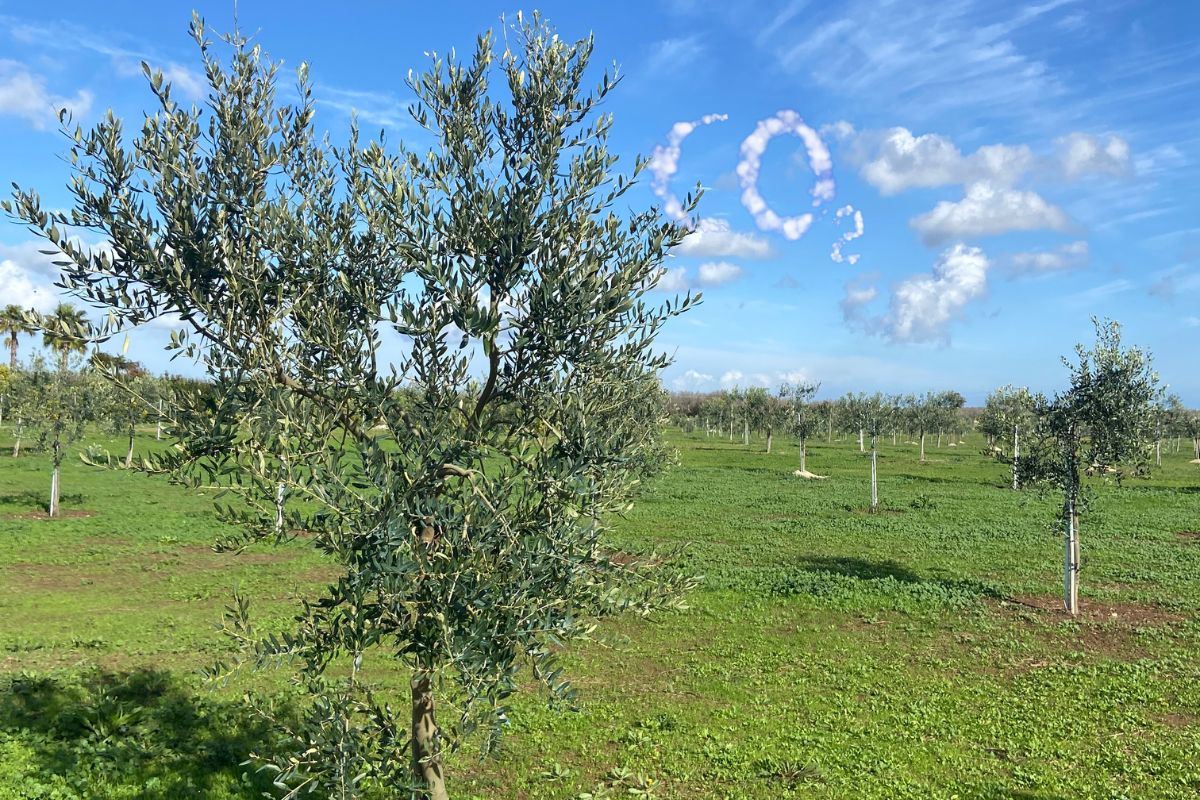
To understand their absorption capacity, we conducted surveys in our olive groves and, after taking into account various variables such as age, tree size, and planting density, we concluded that each olive tree is capable of absorbing , on average, about 300 kg of CO2 per year (for the first 20 years of its life). This means that each olive tree is capable of absorbing about 800–850 grams of CO2 every day.
We always emphasize that every tree has its own absorption capacity, so it is possible that one tree may have a greater or lesser absorption capacity than another, even under the same conditions.
This therefore represents a very significant absorption capacity, far greater than that of other plant species.
Why is the removal of CO2 from the atmosphere so important?
Given their potential to absorb CO2 and the environmental benefits they provide, olive trees also play a vital role in mitigating climate change.
Promoting and encouraging reforestation with olive trees therefore helps reduce CO2 levels in the atmosphere and preserve ecosystems that have been weakened—and in many cases nearly destroyed—by the arrival of Xylella in Salento.
With this in mind, OlivaMi’s spin-off“Carborea”was launched, an innovative social enterprise dedicated to helping companies launch real sustainability projects that have a tangible impact on the Salento region and on local communities severely affected by the Xylella bacterium (click here to read more about Xylella), all through the purchase of carbon credits generated by new olive groves in Salento.